Kurt Bassuener
Book Review:
John Keane, The Shortest History of Democracy: 4,000 Years of Self-Government – A Retelling for Our Times. The Experiment, New York. 2022
Occasionally, an airport book display presents a volume which grabs me. John Keane’s The Shortest History of Democracy: 4,000 Years of Self-Government – A Retelling for Our Timeswas on a bookshelf at Dulles International is one such book, I am very glad that I read it. And I am also glad that this book – just a few years old now – is being recognized as a book of popular interest in these times of change, for either end-of-season vacationers or the business traveler set. The fact that it’s four years old and on display now is noteworthy. I applaud whoever chose to do so, for the book highlights the contemporary challenges to democracy, which are far more acute now in the Trump 2.0 era.
Overall, it’s a brilliant survey of the development and ever-evolving practice of democracy. I learned a great deal from reading it. It also bears note that it reads very well. What’s truly excellent is that he really broadens the story to include precursors to Athenian assembly democracy, where the story typically begins, all the way back to antecedents in Mesopotamia at the advent of recorded civilization, as well as the cosmological mirroring involved – the gods were plural and debated each other. To me, this was a completely new angle, but one whose logic seems self-evident – once presented. Efforts to hold human power accountable go way back.
His categorization of assembly democracy (citizens meeting in person to make decisions), representative democracy (citizens electing representatives to decide on public matters), and postwar evolution of what he defines as monitory democracy – the engagement of broad elements of watchdogs and civic assemblages outside formal democratic representational structures in the public accountability ecosystem – was also very well presented and justified. Again, in each segment, there were stories which were familiar, and those which I wish I had known of long ago – like the 1980 “smile revolution” in Uruguay. While it didn’t return democracy in one leap, it did draw a line and prevent the normalization of the “civil-military” regime which seized power in 1973 – and set the stage for democracy’s return. I wonder how much the Chileans saw this as a reference point for their own “no” campaign in the plebiscite in 1988 which prevented Pinochet’s entrenchment.
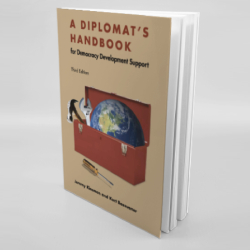
It was only when I got to the reference on Czechoslovakia and the on-the-ground dynamics of what later became known as “the Velvet Revolution” in November 1989 that the synapse fired: is this the same Keane who wrote that great (and much longer) biography of Václav Havel, one of my heroes? I’d read that years ago, when working on the Diplomat’s Handbook for Democracy Development Supportwith Amb. Jeremy Kinsman – Havel wrote a preface for it. Sure enough, it is. Professor John Keane is Professor of Politics at the University of Sydney and Wissenschaftzentrum Berlin, as well as founder of the Centre for the Study of Democracy in London and the Sydney Democracy Network.
Keane also writes convincingly on the reality that democratic practice is undergoing constant evolution and tailoring to local circumstances, customs, and desires. The central sine qua nons of democracy in his taxonomy are legal, systemic, and norm-based protections for human dignity against unaccountable power, as well as citizen agency in democratic systems. He lists a number of practices which developed all over the globe – participatory budgeting, citizens’ assemblies, and so on – and caught on far more widely.
Finally, Keane surveys the scope of the threats and challenges to democracy – and presents his view that the neoliberal capitalist model and wealth stratification itself presents a threat to democratic practice, by empowering a narrow stratum in pursuit of policies for their own benefit and entrenchment. Furthermore, he observes the direct threat to not just human life, but all life on earth, from these power imbalances, as well as the practices of “poligarchs” who have developed impressively resilient and mutually reinforcing systems to maintain and deepen their power.
Fast forward to the near future of 2026. The threats to democracy and life on Earth as we know it are even more clearly defined. To the former, Trump’s re-election in 2024 brought an unrestrained, hungry, and vengeful administration to office which dispensed with even ostensible support for democracy abroad in favor or pursuit of national interest, “dominance” (including in generating and burning hydrocarbons), and “civilizational” identity – lamenting a Europe which began “contracting” in 1945. It also turned on a Ukraine defending itself against Russian imperialism, directing the material support for its counteroffensive to Israel’s conduct of a genocidal campaign in Gaza – and later to an unprovoked war with Iran. Meanwhile, democratic practice at home came under direct, concerted assault, including the ability of voters to select their representatives and even practice the franchise, as well as efforts to “destroy the administrative state,” as Trump ideologist Steve Bannon put it early in the first term. This has been enabled by the complete subordination of the Republican-led Congress to Trump and the disposition of the US Supreme Court to accept a “unitary executive theory” which amounts to a throwback to the pre-1789 divine right of kings.
Trump has also acted as a force multiplier for AI billionaires, championing their breakneck construction of environmentally devastating data centers. More than any other action on the home front, this has brought together communities – even those which overwhelmingly voted for Trump – to protect their water, pocketbooks, and each other. The aggregate political impact of this backlash remains to be seen. But to pan out, a cursory look at Europe, Latin America, Africa, and the whole sweep of Asia and Oceania demonstrates that the threats to democracy from within are far from simply an American issue. But nor is the popular will to organize to push for and defend systems of institutionalized dignity and agency – and there is much to learn from the front lines in locales as disparate as Kathmandu, Kampala, and Tirana.
Keane closes on a hopeful note which I will quote:
(D)emocracy shows us that no man or woman is perfect enough to rule unaccountably over their fellows, or the fragile lands and seas in which they dwell. Is that not a global value?