
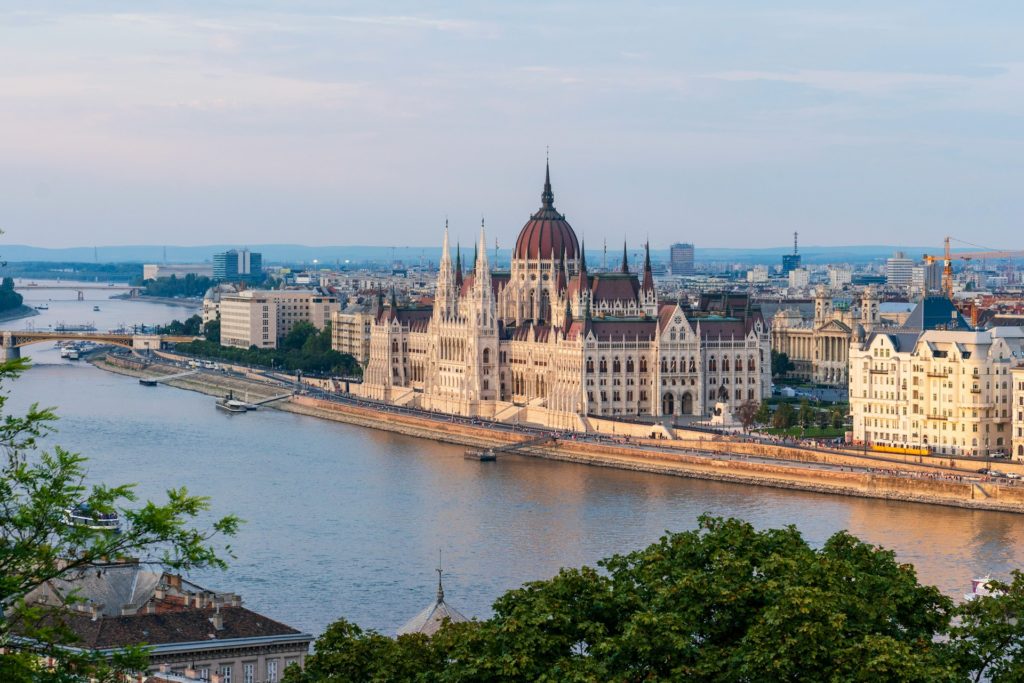
One could practically hear a collective sigh of relief across the European Union when Péter Magyar’s opposition party won a resounding victory and incumbent Prime Minister Viktor Orbán conceded defeat in Sunday’s crucial elections in Hungary. The election was critically important to the people of that country, but it had also become a battleground for Russian disinformation, anti-Ukrainian messaging, amateur false flag claims of terrorist threats from Serbia, and the injection of American MAGA-right wing nationalism, which itself has been very much inspired by the illiberalism of Orbán’s 16 years in power.
The congratulations are rolling in from leaders from across the European Union. Experience and the mindset of the Brussels technocratic machinery suggest that the EU will view this as a reset signaling that everything has turned for the better in Hungary and that everyone can return to business as usual. However, this moment should be seized as an opportunity for renewal and reflection. It should inform current and future policymaking by the EU, EU member states, and the broader democratic community.
Orbán’s loss and Magyar’s win is yet another important bellwether for understanding the rise of Hungary’s illiberal state model, while also now pointing to techniques for resistance to and reversal of such antidemocratic trends.
A first step
For the people of Hungary, this is an important step – but only the first – in rolling back the political, social, and economic damage of the past 16 years. The experience of Poland under the Law and Justice Party (PiS) suggests that it’s far easier to break institutional systems and trust than to (re)build them.
It is heartening that Magyar has noted his commitment in restoring relations with the EU and NATO; this in itself will be a great asset in removing what had often become a weight on these institutions. But it bears repeating that Magyar himself comes from Fidesz and is part of the center-right mainstream. There is no reason to think that culture war issues will simply go away. In fact, it’s very important to remember that there is now a global network of wealthy and connected people who have demonstrated they are willing to spend money and political capital supporting the Orbán vision. Magyar will face numerous challenges as he seeks to rebuild institutions and employ judges and other civil servants who are committed to the country rather than just a party or an individual. Constitutional reform needs to be part of this rebuilding. Throughout the process, Magyar’s government will need to learn how to explain what they are doing and why to the people of Hungary, who have grown accustomed to rhetoric from a state machinery retrofitted to suit Fidesz – what has been termed a “competitive authoritarian regime.” The media machine that has been created over the years by Orbán’s cronies, who together with the state control an estimated 85% of the media, will in particular be difficult to dismantle and rebuild.
Clean-up job
A lot now depends on how Magyar works to clean up Hungary’s systems, as he and his team dig-out a decade and a half of corruption and self-dealing. It’s important to remember that it was the shared frustration with endemic corruption that enabled a unified opposition and brought 77% of the people out to vote. This shameless and widespread corruption (described as a “post-Communist mafia state” as early as 2016) naturally accompanied the building of a state based on power, self-dealing and patronage, and which enabled the erosion of governance and services that ensues when bureaucrats and independent experts are bullied and replaced with loyalists and sycophants. It took people getting fed up with this corruption to lead to this opposition victory. It will be interesting to see what connections, European and beyond, will be exposed in the coming weeks and months. The recent revelations of Foreign Minister Peter Szijjarto’s reporting to his Russian counterpart, Sergei Lavrov, from EU meetings on sanctions like a control officer, foreshadow more such linkages.
Soul-searching in Brussels – and beyond?
At the level of the European Union and its machinery in Brussels, this development should prompt some soul-searching on how certain aspects of the EU itself enabled Orbán’s long hold on power. Let’s not forget how long it took to get Fidesz out of the center-right pan-European EPP; Fidesz finally left on its own in 2021 – Orbán’s 11th year in power – following suspension in 2019, but remaining in the EPP European Parliamentary group for another two years. This network has a lot to answer for in nurturing Fidesz (and other reactionary “national conservatives”). It will be interesting to see if they maintain public and friendly links with politicians and other reactionary figures coming over from the other side of the Atlantic. Closer to home, it’s important to remember that the EPP is still “investigating” Serbia’s ruling SNS following the numerous abuses of power by the party and President Aleksandar Vučić.
In fact, the frustrations that finally hit a boiling point among people in Hungary will sound extremely familiar to citizens throughout the Western Balkans, who similarly feel that they have lost a generation to the same corrosive political and economic trends, following wider hope a generation ago in most of these countries. They have all experienced a different flavor of kleptocratic self-dealing and poor governance for much of the past three decades, layered on top of the trauma and dislocation of the violence that accompanied the destruction of Yugoslavia.
These trends also are becoming increasingly familiar to citizens of the US who have seen an even more rapid-fire dismantling of checks and balances and expertise over the past 16 months.
Defending democracy
The EU (and the broader set of democratic countries that have been described by Canada’s Prime Minister Mark Carney as “middle powers” and by DPC as “Europe+”) would do well to learn from this and other cases to better formulate and message their own policies and remind their citizens of why democratic values and human rights are not just some lofty ideal but are inextricably related to governance success, broad-based and shared prosperity, and comprehensive security.
Hungarians have demonstrated that democracy can and must be defended from below – and that it helps to have convincing, inspirational leadership which recognizes that need for a broad popular coalition in favor of a governance system based on rules, not connections or loyalty.
The EU should also consider the lesson that should be learned in terms of its enlargement agenda. Corruption and political and social control are not bugs in the system of countries struggling to move towards healthier democratic systems and ultimately EU membership. Rather, they are the feature of authoritarian and kleptocratic regimes that have as their bottom line consolidating and staying in power.
No business as usual
Tisza’s overwhelming victory cannot be an excuse for the EU simply breathing a sigh of relief, then coasting or returning to business as usual. The Union and its member states failed the diagnostic test that 16 years of Orbán’s increasingly disruptive rule – and his now demonstrated service to Moscow (and Trump’s MAGA movement) – posed to the EU as a community of rules and values. This needs to be remediated, including through developing EU-wide popular democratic defense and resilience. The influence of malign actors in Europe’s neighborhood and in the EU itself will only become more sophisticated and targeted. Finding ways to inoculate themselves from these infections will be critical and will include efforts to identify and counter disinformation, but also to find ways to maintain digital sovereignty over their information space. This will be needed to counter not only Russia but a United States under Trump and with its own emboldened and increasingly unaccountable Silicon Valley class. This class has weaponized US state power against the EU’s ability to defend the privacy and interests of its own citizens.
However, for now, before sitting down to understand what happened to bring about this result and what could happen next at a time of global uncertainty and risk, one can be forgiven for wanting to exhale – and celebrate. But it should be taken not as a signal that everyone can relax, but as a moment that should be seized to regain the progress, momentum, and values-based self-confidence that the democratic world has allowed to shrivel during a period in which antidemocratic forces have shown increased swagger.